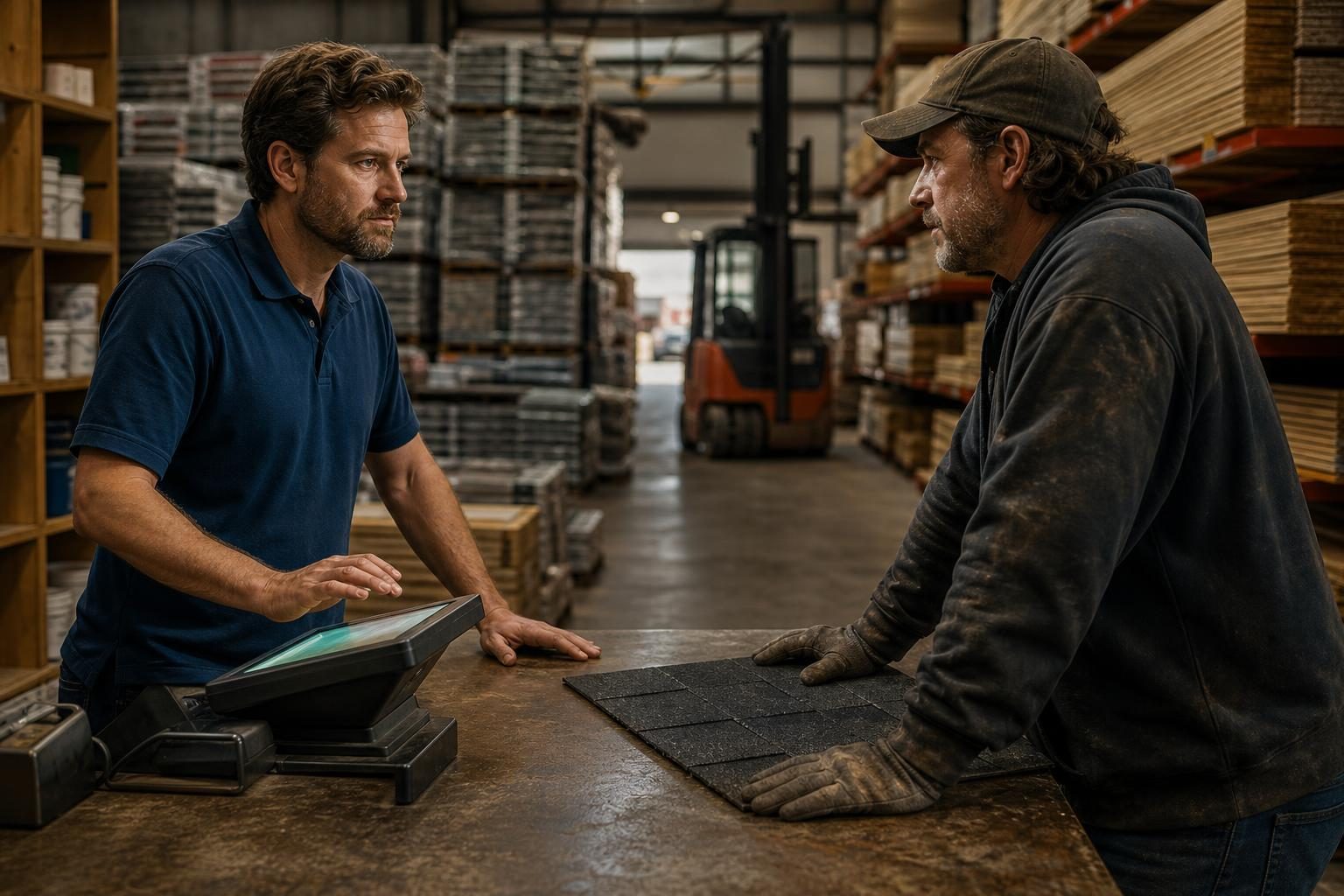
Once a rep cuts the price for nothing, the customer will ask again next time.
A longtime customer calls about a reorder. "Can you do any better on price?"
The rep likes this customer, and the order is a big one. The rep has a few seconds to answer.
Many reps say something like, "Let me see what I can do." It sounds harmless. But the customer just learned that asking, by itself, is enough to move the price.
Executives are paying attention to these moments. On a recent call about QXO's third-quarter results, CEO Brad Jacobs told investors his company had "instilled more rigorous governance over excessive price overrides and improved the tools, management, and incentives that support pricing decisions." QXO's pricing rose 2.2% in the third quarter from a year earlier.
Rules and tools like that help. But a rule can't answer the customer. The rep has to.
By the time a discount is approved, it's already promised
Many companies check discounts after the fact. A rep asks for an override, and a manager says yes or no. But by the time the request reaches the manager, the customer has usually heard something that sounds like a yes. Saying no now means taking back a promise. So the real decision happened earlier, in those few seconds on the phone.
In our experience, plenty of reps know what they should say in that moment. Far fewer have practiced saying it to a customer they don't want to lose.
So let's follow one rep through the three moments where it gets hard.
Moment 1: "Can you do any better?"
Picture Sam, a sales rep for a building-supply distributor. A roofing contractor Sam has served for six years calls in an order and asks for a better price.
Sam wants to be helpful, so Sam takes 3% off on the spot. It feels like good service. But now the contractor knows the price was never firm.
A better first move is a question: "What changed since your last order?" The price was fine last time, so something is different now. Maybe a competitor sent a quote. Maybe the contractor bid this job too low. Maybe a client is squeezing the budget. Each answer calls for something different, and none of them calls for a lower price yet.
Moment 2: The customer pushes back
The contractor explains that margins on their jobs are tight this year. Can Sam help?
This is where many reps give a little more, just to keep things friendly. It feels small. But it costs margin and buys nothing. It also teaches the customer that asking twice works.
A better move is a trade. If the price moves, something else moves with it: a bigger order, a longer commitment, or a delivery schedule that costs less to run. The contractor gets a better number, and Sam's company gets something back.
Moment 3: "Maybe I'll try someone else"
Then the contractor says it. The supplier across town will do it for less.
This is the hardest of the three. Many reps give in to save the deal, and the deal is saved. But the contractor just learned that the threat works. So the next reorder can start with the same request, backed by the same threat.
The stronger move is calmer than it sounds. Sam reminds the contractor what they get today, offers the trade again, and is ready to let the order go. That only works if Sam's manager said before the call which deals the company would rather lose.
Why knowing the right answer isn't enough
Sam knows the pricing rules. Sam may even have a script. The hard part is saying those words to a customer Sam likes, while that customer is waiting for an answer.
So where does Sam practice that part? Usually in a role-play with a coworker. But Sam doesn't care about the coworker's business, and nothing said in the role-play changes how the next one goes. Sam learns the words without the pressure. So the first time Sam feels the pressure is on a real call, with a real customer and a real order.
Practice that feels like the real call
Blueline builds High-Stakes Performance Simulations for sales teams to close that gap. Picture one: Sam talks with a contractor who feels like a real customer, with a business to run, a history with Sam, and a reason to push.
If Sam gives in, the contractor remembers, and the next reorder opens with the same request. If Sam holds the price and offers nothing, the contractor pushes harder. If Sam offers a fair trade, the contractor gets a better number, and Sam's company gets something back. Sam feels each choice land, the way it would on a real call. We call this Emotional Consequence.
To build a simulation like this, we work with a client's best reps to map the moments where price slips, like the three above. We call that Decision-Consequence Mapping™ (DCM™). What makes that practice possible at enterprise scale is BluEQ™, Blueline's proprietary behavioral intelligence infrastructure. It is why the contractor remembers what Sam did and responds the way a real customer would.
At DevLearn, visitors kept telling us how real the scenarios and characters felt. That feeling is the point. Holding price is only hard when the customer feels real.
What changes on the next real call
After a few runs, Sam has given in, held firm and offered a trade, and has felt how each one played out. So when a real contractor asks for a better price, Sam has already practiced that moment.
Every choice Sam makes in the simulation is also on record. So you can see where each of your reps held price and where they gave ground, and start coaching there. Over a quarter's worth of reorders, that is what moves your discount rate and price realization. If you need to make that case inside your company, the ROLI Blueprint shows how.
Start with one question
Ask your sales leaders which of these three moments costs your company the most price today.
Have your reps practiced holding price with a customer they want to keep?
Request a private demo to see that conversation built as a simulation. Then read the ROLI Blueprint.
Source: QXO, Inc., Form 8-K, Exhibit 99.1, "Transcript: Brad Jacobs Conference Call."